
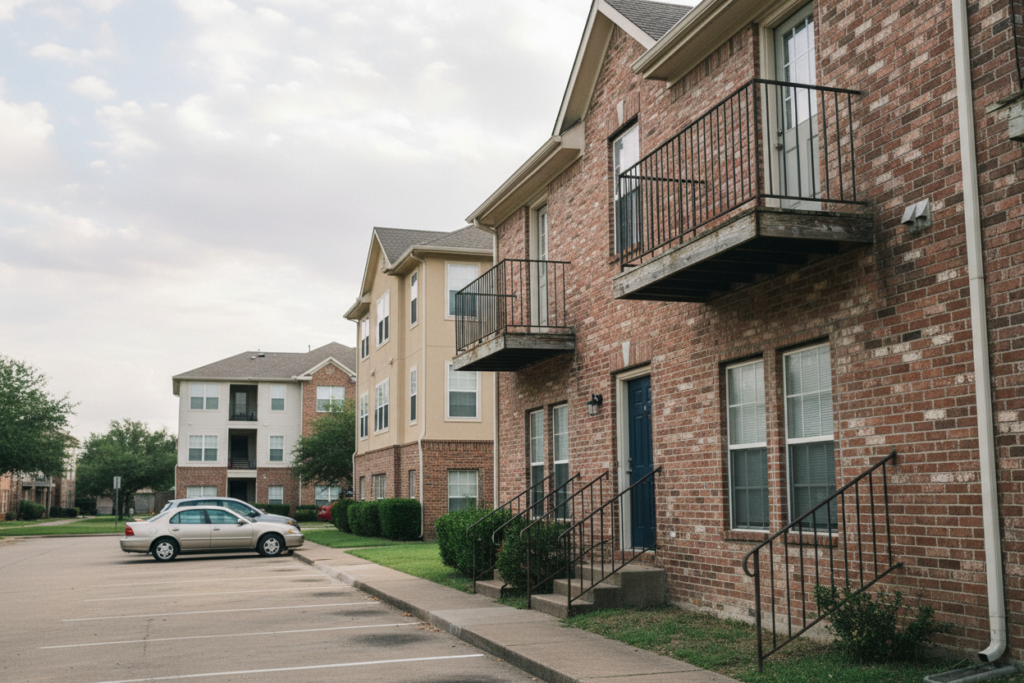
Sponsors sell deals with a letter. “Class B value-add” or “Class C turnaround” shows up on page one of the offering memorandum, and limited partners are expected to know what that means. No regulator defines those letters. So passive investors end up guessing at the real risk, the real capital budget, and the real business plan.
Two numbers explain why the distinction matters right now. The Joint Center for Housing Studies of Harvard University counted 608,000 multifamily completions in 2024, the highest annual total since 1986. Research published by the National Multifamily Housing Council found the number of apartments renting below $1,000 a month fell by 4.7 million units between 2015 and 2020.
New construction is running hot at the top of the market. The affordable half keeps shrinking. The letter grades sit directly on top of that split, and so does the rate exposure carried by the debt behind each business plan.
Apartment classes are market conventions, not legal categories. Brokers and sponsors use them to sort a property by age, condition, location and tenant profile. Class A is the newest and priciest tier. Class B and Class C cover the older workforce housing that most value-add syndications buy.
Key Takeaways
- Class A assets carry premium finishes and prime locations, and they compete head on with every new lease-up in the submarket.
- Class B stock is usually 15 to 30 years old, houses middle-income renters, and fits cosmetic renovation plans.
- Class C stock is usually 30 years or older, houses lower-income renters, and needs structural and operational work before rents move.
- Demand for workforce housing runs deep because construction costs make new building at those rents impractical. Deep demand is not a guarantee against loss.
- The letter is a shorthand for the business plan, the capital budget and the debt behind it, so read it as a risk-adjusted return profile rather than a quality score.
The Grading System Has No Official Standard
The letters are shorthand between brokers, lenders and sponsors. No agency publishes a boundary between one class and the next. The local market sets the line.
A new mid-rise in a secondary Midwest market gets a Class A label at home, even without the amenity package of a downtown Dallas tower. Judge the asset against its actual competitors, not a national ideal.
For business owners and self-directed IRA holders, that relative scale is what drives the risk-adjusted return profile. The class tells you the business plan. It tells you whether the sponsor intends to hold a stabilized property for yield or gut half the units to force appreciation. That is the first thing to check when you read a multifamily syndication offering memorandum.
Class A: Premium Finishes, Crowded Field
Class A apartments set the high end of a submarket. They are usually under 10 years old, with resort-style pools, smart home technology and upgraded interiors. The renters are high earners who rent by choice rather than necessity.
The appeal is low deferred maintenance. Roofs, plumbing stacks and mechanical systems have years left, so the buyer is not funding a capital program on day one.
The pressure comes from supply. Land, labor and financing costs push new development to the top of the rent range, because nothing else pencils. Every new lease-up competes with the Class A property next door. When demand softens, Class A operators cut effective rent through concessions, and the owner absorbs the difference.
These assets also arrive close to their ceiling. Rents already match the best product in the market, so operations leave little room to push net operating income higher.
Class B vs Class C Multifamily: Where the Value-Add Model Lives
Workforce housing carries the value-add syndication model. When a sponsor talks about off-market acquisitions, the target is almost always the middle or lower tier.
Class B buildings run roughly 15 to 30 years old. The structure is sound and the interiors are dated. Tenants are stable middle-income earners: teachers, nurses, municipal workers and skilled trades. The plan is cosmetic. New flooring, new counters, updated lighting, tighter management, higher net operating income.
Class C buildings usually pass 30 years, sit in secondary locations, and house hourly wage earners. Deferred maintenance is the headline. Roofs, electrical panels and sewer lines come first. Rent increases come after.
The cash flow profiles differ more than the rent rolls do. A heavy Class C repositioning consumes capital early, and a sponsor often holds distributions back to fund the work. A stabilized Class B asset produces cash sooner because less of the building is torn open at once.
Read the class as a staffing question too. Ask whether the sponsor has run this tenant base and this construction scope before, in this market.
| Factor | Class A | Class B | Class C |
|---|---|---|---|
| Typical age | Under 10 years | 15 to 30 years | 30 years and older |
| Condition | New systems, minimal deferred maintenance | Sound structure, dated interiors | Significant deferred maintenance |
| Renter profile | High earners renting by choice | Middle-income workforce renters | Hourly and lower-income renters |
| Rent position | Top of the submarket | Below new construction, above Class C | Bottom of the submarket |
| Capital needed after close | Low | Moderate, mostly cosmetic | High, structural and mechanical |
| Common business plan | Hold a stabilized asset for yield | Light to moderate value-add | Full repositioning |
| Main risk to watch | New supply and rent concessions | Renovation timing and execution | Capital overruns and collections |
Why Workforce Housing Demand Holds Up
Investors in Reg D private placements usually weigh capital preservation alongside tax efficiency. Workforce housing answers part of that question. No apartment class removes risk.
When the economy slows, Class A renters trade down. That migration lands on Class B and keeps those buildings full. Class B renters rarely drop to Class C unless the financial pressure is severe, and Class C stays occupied because it is the floor of the market.
Supply explains the rest. A developer cannot build today and rent at Class B rates without losing money, so most new Class B stock appears when yesterday’s Class A ages into it. Affordability pressure compounds the effect: between 2001 and 2024, renter incomes rose 9 percent after inflation while rents rose 30 percent, according to the Harvard center’s 2026 rental housing report.
None of that suspends the cycle. Occupancy slips, values move with cap rates, and use amplifies both directions.
Operational Challenges in Value-Add Multifamily
Older communities carry specific operating burdens. A sponsor cannot buy one and wait for inflation to do the work.
Capital expenditure is the first hurdle. Older buildings run older systems. Cost segregation accelerates depreciation and creates paper losses, but a paper loss does not replace a chiller. A missed foundation or HVAC estimate drains reserves and can force a capital call.
Tenant credit sensitivity is the second. Workforce renters live closer to their paycheck than premium renters. Screening and collections have to stay tight without emptying the building in the middle of a renovation.
Insurance is the third. Property insurance renewals across Texas and the Plains have reset hard, and one renewal can move an operating budget more than a full year of rent growth.
Property tax reassessment is the fourth. A sale resets assessed value in many jurisdictions. Underwriting that carries the seller’s tax bill forward understates expenses from day one.
Resident turnover is the fifth. Renovation programs displace residents who cannot absorb the new rent. That costs vacancy, concessions and time before the higher rent ever shows up.
Interest rate exposure runs underneath all five. A B or C class business plan often assumes a refinance once the renovation is done, and a rate move between purchase and refinance changes the outcome more than the renovation budget does. Long-term, fixed-rate, non-recourse debt at conservative use is the structural answer, which is why the loan terms in an offering deserve as much reading time as the unit interiors.
Sponsor alignment is harder to see from the outside. Read how the sponsor gets paid, how much of their own capital sits in the deal beside yours, and how often they report while the money is at work. A sponsor who reports monthly through a heavy renovation is easier to hold accountable than one who surfaces at year end.
Tax reporting adds friction for out-of-state limited partners. A syndication reports on a Schedule K-1 rather than a 1099, the K-1 often arrives later in the season than a brokerage statement, and owning property outside your home state can create a filing obligation in that state. Depreciation and cost segregation are real advantages of holding real estate through a partnership, and the paperwork that carries them is heavier than a fund statement. Ask your CPA how a K-1 from each market will land on your return before you commit.
What Renter Demographics Point To Next
Mortgage rates have kept a large group of would-be first-time buyers in the rental pool. Those households rent longer than the generation before them, and most of them rent Class B.
Population and job growth across Texas and the Plains states add to it. Employers keep expanding in those markets, and the regulatory environment for owners is friendlier than on the coasts. That combination supports steady demand for well-run, mid-tier communities.
How Well Capital Applies Buy Right, Finance Right and Manage Right
Well Capital is a multifamily sponsor based in Fort Worth, Texas. The firm acquires, repositions and operates off-market B and C class apartment and townhome communities across Texas and the Midwest, and offers limited-partner positions to passive investors. It is not a REIT, not a crowdfunding portal, and not a third-party property manager.
Buy Right means off-market B/C-class assets in desirable neighborhoods, bought on fundamentals, cash flowing at purchase, with room to force appreciation during the hold.
Finance Right means long-term, fixed-rate, non-recourse debt at conservative use. That pillar answers the interest rate exposure sitting under every older asset.
Manage Right means vertical integration. The team operates the properties instead of handing the business plan to a third party. The portfolio now covers more than 1,190 units across 12 communities.
The structure is plain. Minimum investment is $10,000. The sponsors put at least 5 percent of the capital into every deal. Distributions are paid quarterly, with monthly updates in between. Ten percent of sponsor profits goes to charity:water, which is the impact investing side of the model.
How to Know Which Apartment Class Fits Your Portfolio
Want daily liquidity and zero operational exposure? A publicly traded REIT weighted toward Class A core assets fits better. You trade the tax treatment and the control for the ability to sell on a Tuesday.
Want depreciation, quarterly cash flow and the upside of forced appreciation? An older asset held through a passive real estate syndication lines up better. More of the basis sits in short-life components, and physical improvements move net operating income directly.
Either way, the letter tells you what the sponsor has to execute. Match that plan to a team with a record of doing exactly that work, with that tenant base, in that market.
If you want to see how a Fort Worth sponsor underwrites B and C class communities across Texas and the Midwest, start with the investor resources, then complete the investor questionnaire to open a conversation with the team.
This article is general education. It is not an offer to sell or a solicitation of an offer to buy securities, and it is not financial, tax or legal advice. Any offering is made only through official documents to qualified investors. Consult your own CPA or attorney before you invest.
Related reading
Frequently Asked Questions (FAQs)
What is the main difference between Class A and Class B apartments?
Class A apartments are newly built communities with luxury amenities and top-of-market rents, aimed at high earners who rent by choice. Class B apartments run 15 to 30 years old, with sound construction and dated finishes, and they house middle-income workforce renters.
Is Class B or Class C multifamily better for a value-add strategy?
Both work, but they ask for different things. Class B usually needs cosmetic upgrades to reach a rent premium. Class C needs structural repairs and an operational turnaround first, which ties up more capital before any rent increase shows up.
How do value-add multifamily syndications force appreciation?
Forced appreciation is raising a property’s value by raising its net operating income. Sponsors renovate units to support higher rents, tighten collections and cut operating waste. Commercial property is valued off income, so a higher NOI at the same cap rate produces a higher valuation, which is what carries a value-add plan through a flat rent market.
How does investing in a Reg D multifamily syndication differ from buying a REIT?
A REIT is a company you buy shares in through a brokerage account, with daily liquidity and dividends taxed mostly as ordinary income. A Reg D private placement is a direct limited-partner interest in specific properties, offered to qualifying investors, reported on a Schedule K-1, and held until the sponsor sells or refinances. The private structure passes depreciation through to you and names the asset and the operator. The tradeoff is illiquidity and a slower reporting cycle. Well Capital is a private sponsor, not a REIT and not a crowdfunding portal.
Why do sponsors target Texas and the Midwest for workforce housing?
Those markets combine job growth, population growth and landlord friendly regulation. Basis is lower than on the coasts, so the same renovation dollar buys more rent lift. Well Capital operates in Fort Worth, Richardson, North Houston, Corpus Christi and Rockport in Texas, plus Sioux Falls, Bismarck, Lincoln and Omaha.